Radiation by the Stack’s Mouth
In order to consider the screening and the reflecting effect of the chimney correctly and, in particular, to display the chimney in the 3D-representations correctly the cylinder is used in CadnaA.
By a specific configuration setting it is ensured that the cylinder itself does not cause a screening effect to the point source representing the radiation from the chimney’s opening.
-
Switch the scale to 1:1000 and select the cylinder from the CadnaA-toolbox (symbol:
 ).
). -
Click to the middle of the main window. This first polygon point represents the center of the cylinder.
- Drag the mouse at the side to fix the radius. The length (in this case the radius) is shown along the line. Click with the mouse button once more when the value is about 3 m. A circle is drawn representing the cylinder in xy-plane.
- Double-click on the cylinder’s border and click on the button "Geometry".
- Enter a radius of 3 m and a height of 20 m.
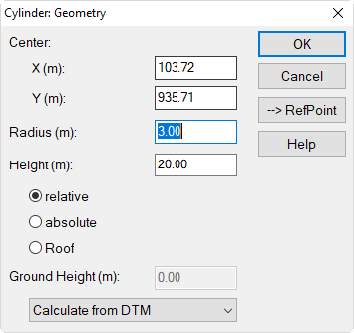
Geometrical data of the cylinder
- Select the point source in the CadnaA toolbox and put a point source in the center of the cylinder using the mouse.
- Click with the right mouse button on border of the point source to open it’s the dialog.
- Enter an A-weighted sound power level of 100 dB(A) and click on the button "Directivity“.
- On the dialog Directivity, select from the predefined directivities the option „Chimney (VDI 3733 (1996))“ and enter the following data:Exhaust Velocity: 5 m/sExhaust Gas Temperature: 150 °CWind Speed: 3 m/s
- Close the dialog Directivity and click on button „Geometry“.
- Enter a height of 19.95 m for the point source.
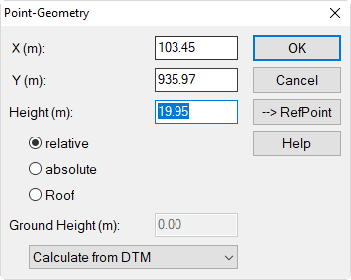
Specifying the height of the point source
- Close the point source’s dialog and select the command Configuration from the Calculation menu. Then click on the tab „Industry“.
- Activate on tab „Industry“ the option "Sources in Building/Cylinder do not shield“.
By activation of this option it is ensured that the cylinder’s screening effect is not taken into account twice: on the one hand due to the pre-defined directivity "Chimney (VDI 3733 (1996))" - which includes the screening effect in its data set - and, on the other hand, in the calculation of sound propagation where the cylinder’s edge provides screening as well.
This option being activated in CadnaA, the cylinder as screening object for the point source is ignored in calculation of propagation (resulting in Abar = 0 dB for those rays).
-
The vertical grid is used to represent the result. Select this object from the toolbox (symbol:
 ).
). -
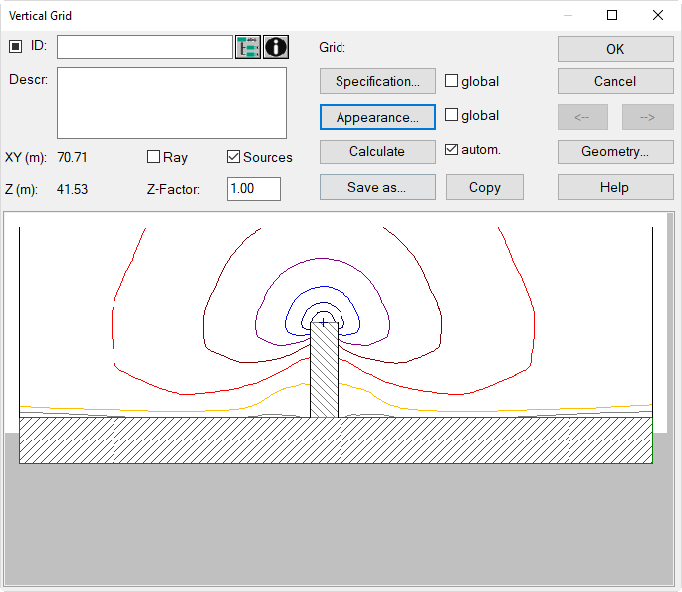
Draw the vertical grid made from 2 polygon points across the cylinder with the cylinder’s circle in the middle of the line approximately.

Vertical grid to display the radiation from a chimney
- Double-click on the vertical grid and enter via button „Geometry“ a height of 40 m (= top edge of the vertical grid).
- Deactivate the dialog option "global" beneath the two buttons "Specification" and "Appearance".
- Enter a grid spacing via button "Specification" of 1x1 m and select the „Lines of Equal Sound Level“ via button "Appearance“.
- Start the calculation by clicking the button "Calculate".
The result indicates that there the cylinder does cause no screening as this effect is already considered by the directivity pattern.
You can convince yourself that the screening effect of the cylinder is not included by inserting a receiver point.
- Enter a receiver point near the cylinder.
The receiver point has per default a height of 4 meters. If the cylinder causes screening it should result in a reasonable value of Abar on the calculation protocol.

Chimney with a close receiver point
- Select the command Protocol on the Calculation menu and activate the option "Write Protocol".
-
Run the calculation clicking the pocket calculator symbol
 .
. -
Open the dialog Protocol again and click the button "Print".
- Choose the protocol preview for the receiver IP1.
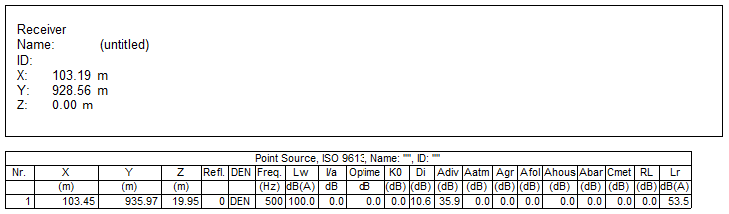
Protocol for receiver point: Abar = 0 dB
The protocol shows that no screening effect by the cylinder has been accounted for. A receiving level of 54.3 results - in this example - is just due due the radiation from the chimney’s opening.