Barrier staggered in height
The calculation procedures for sound propagation outdoors do not cover barriers with sections staggered in height and having different absorptive properties. Screens (and all other types of obstacles) always have a uniform reflection loss or absorption coefficient on each barrier side.
Due to the practical relevance of such a barrier design, the recommended procedure in CadnaA is described below. A barriers with sections staggered in height is modeled by two distinct barriers, the base line of which are close to each other (e.g., at a distance of 0.10 m).
To this end, the barrier having a higher absorption coefficient (larger reflection loss) is facing away from the source, while the barrier having a smaller absorption coefficient (smaller reflection loss) is placed on the source-facing side.
Examples
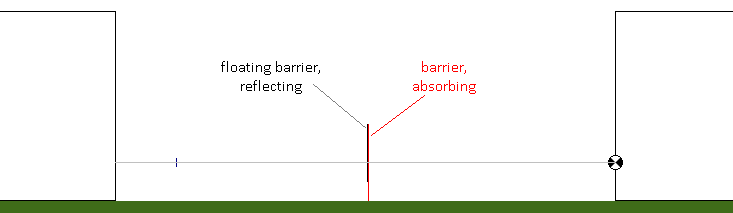
Example 1: barrier with an absorbing lower part and a reflective upper part (modeled from two barriers, vertical cross section):
Example
Path: Examples\Obstacles\Barrier - staggered\example 1 - lower part absorb - upper part reflect.cna
Note
In the 3D-Special view the sound rays are represented as line sources having no emission (resulting from converting the rays being auxiliary polygons).
Example
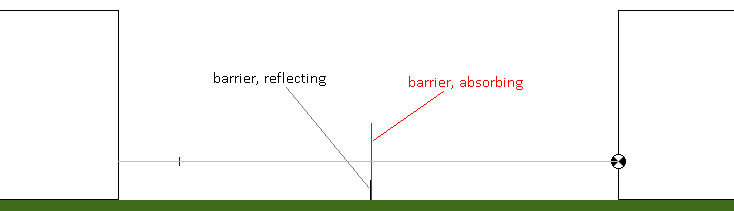
Path: Examples\Obstacles\Barrier - staggered\example 2 - lower part reflect - upper part absorb.cna
Example 2: barrier with a reflective lower part and an absorbing upper part (modeled from two barriers, vertical cross section):
Note
In the same way, barriers can be modeled consisting of several sections having different absorption.
Limitations
The reflected ray paths, generated based on the heights of the source and the reflecting obstacles, hit either the absorbing or the reflecting region of the staggered barrier. Consequently, in a specific geometrical situation, the noise increasing effect may not occur and at each receiver point.
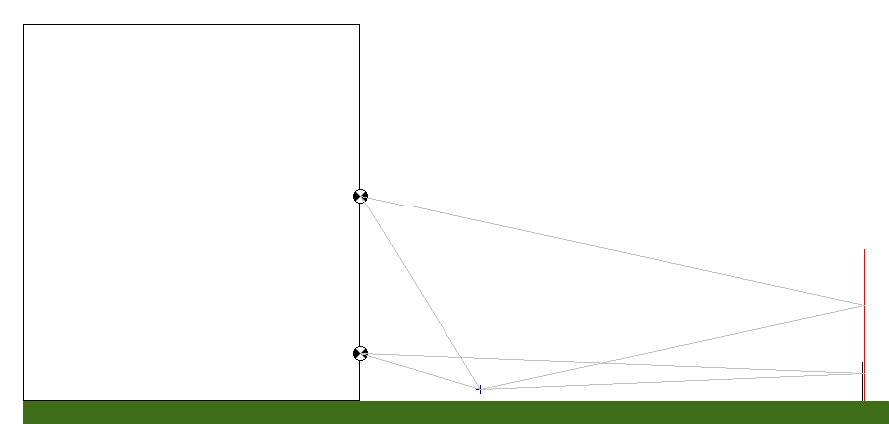
In this example (vertical cross section), there are two receivers on a facade at which reflections of 1st order occur at a barrier with sections staggered in height. The level at the upper receiver is includes the reflection loss of the rear, absorbing barrier, while the level at the lower receiver includes the reflection loss of the reflecting barrier in front.