Reflection of the 1st Order
The calculation of the first reflection is required by certain standards if this reflection contributes to the sound level at the receiver (e.g. according to the guidelines RLS-90 RLS-1990, Schall03 S03-1990).
The calculation occurs in three steps which have to be carried out for each reflective area according to each pair source (Q) - receiver (IP).
-
constructing the position of the mirror sources,
-
sectioning the connecting line of the reflected source - receiver point with an area and determining the breakhrough-point,
-
calculating the part of the sound level according to the longer path of the ray over the reflecting area including the absorption coefficient of this area.
In the example shown below two parts of sound level are taken into account at the receiver (IP) which are calculated from the displayed paths of rays.
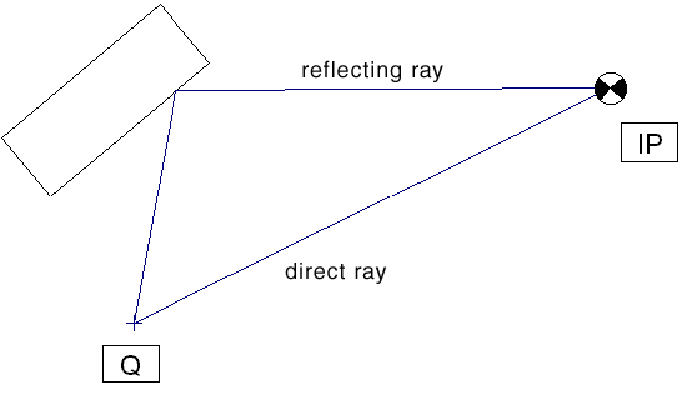
The paths of rays with the reflection of the first order
Important for the correct calculation of reflection, according to the mentioned guidelines, is that all reflections of the first order be checked and, if necessary, be included in the calculation. That is not obvious - software programs exist which check, starting at the receiver, a ray only till the first reflector crosses the path of the ray in the plan, even if this reflector is not affecting anything because of the low height and the area lying behind which reflects the ray. The calculation of reflection must, as in the example of picture A, also find a level-raising contribution if, as in picture B, a low obstacle at the base seems to block the ray’s path.
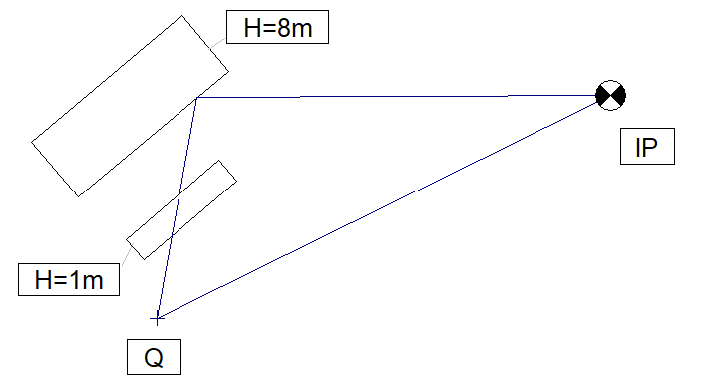
The paths of rays for the reflection of the first order with obstacles in the path of the ray.
A typical example of this case is shown in the next figure. The program only investigates up to the first reflector which is found, then at the house on the left side of the road the amount of reflection which is caused by the high building is not taken into account only because a 1 m high wall is located between this high building and the four lane road. This calculation is not in accordance with RLS-90 in this case.
Besides this, CadnaA takes into account reflections if screening objects obstruct the path of the reflected sound ray. The part of the sound level which was caused by the reflecting sound at the receiver point is then reduced by the value which results from the screening calculation for the path: mirror-source - receiver.
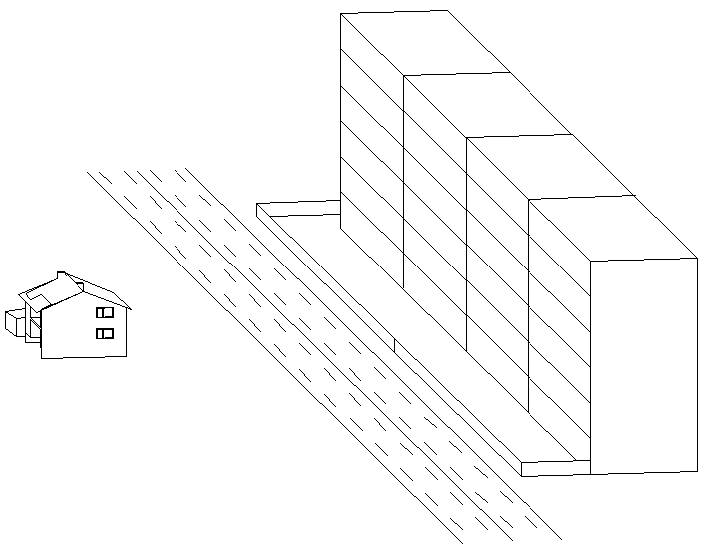
For the calculation of the sound level at the left residential building, according to RLS90, the reflection of the traffic noise on the high right building has to be calculated despite the low wall between the road and the building.
CadnaA also calculates the reflection for extended sources such as line or area sources, but these objects will be split into sufficiently small partial sources. The figure shows the already familiar soccer field with three buildings located in the neighborhood and the paths of rays taken into account.
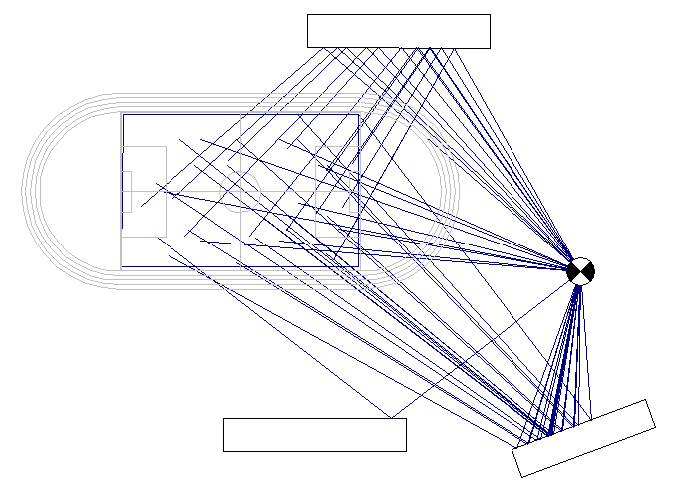
The paths of rays taken into account in a calculation of sound levels on a soccer field.