Sound Rays at Line and Area Sources
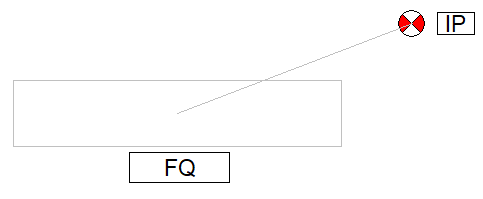
Even in the case of calculating the noise level from an extended source as the area source shown in fig. A, a distance has to be found that can be used in the equation of propagation. This may be wrong if the pivot of the extended source is used as starting point of the ray. Since, actually, each arbitrary portion of the area source emits sound, the same value of a level must result if the total stripe according to figure B is to be subdivided and the sound pressure level at the receiver point is calculated as the sum of the levels of the 5 contributions from the partial sources FQ1 till FQ5.
 |
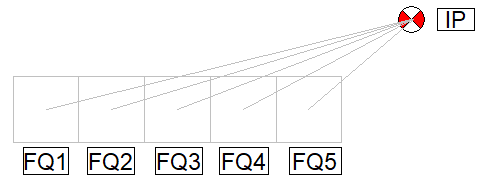 |
However, the partial sources, according to figure B, result in different partial levels because of the different distances. On the basis of the energetic addition a higher sound pressure level results from fig. B than from taking into account only one ray emitted from the pivot as shown in fig. A.
This error has been avoided in CadnaA by partitioning each extended line or area source in sufficiently small parts for automatic calculation.
But these partial areas do not have the same size as shown in figure B. They become even smaller the closer the corresponding section of the extended source is to the receiver.
This dynamic division, which must newly be calculated for each receiver, leads to a considerably faster calculation in comparison to the equal division. The following figure shows the sound rays, which CadnaA takes into account, with the irregularly shaped area source provided below.
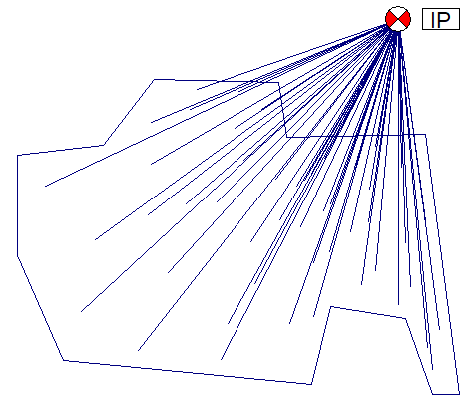
The sound rays of an area source considered by CadnaA.
The same applies to line sources. By the road shown in the following figure the borders of the stripe are the axis of the outer lanes which are each considered as line sources and taken into account in the calculation of level.

The sound rays of a roads considered by CadnaA.