LfU-Study (2007)
Emission
The A-weighted sound power level is the relevant emission parameter with the various Bavarian parking lot studies, however, it cannot be specified directly. CadnaA always displays both emission parameters:
- input of the emission level L*m,E (dBA) for the time periods Day/Evening/Night
- display of the A-weighted sound power level PWL (dBA) for the time periods Day/Evening/Night
Direct Input
For direct input specify the emission level L*m,E (dBA) (individually for the time periods Day/Evening/Night). The value results from sound power level PWL (dBA) according to:
\(L^*_{m,E}=L_{wA}-17dB-19.2dB\)
Number of Events
The sound power level per unit area PWL“ of parking lots calculates according to the „combined procedure“ (i.e. including noise from search and passage of vehicles) according to edition 2007 of the Bavarian parking lot study using number of events PPLS-07:
\(L_W''=L_{W0}+K_{PA}+K_I+K_D+K_{StrO}+10\lg (B*N)-10 \lg(\frac{S}{1m^2})\)
with
-
LW0 = 63 dB(A), initial sound power level for one movement/h on a Park-and-Ride parking lot
-
KPA: penalty for parking lot type
-
KI: penalty for impulsive noise (just for the combined procedure)
-
KD: correction for search and passage of vehicles
-
KStrO: penalty for road surface
-
B: number of reference quantities B0
-
N: frequency of movements (movements per reference quantity and hour)
-
B · N = number of vehicle movements per hour on the parking lot area
-
S: total area or partial area of the parking lot
Applying the „separated procedure“ (i.e. including noise from search and passage of vehicles) the correction terms KD and KStrO are dropped.
Note
The calculation of parking lot emission according to former editions of the Bavarian parking lot study is not described here. The calculation according to earlier editions is still provided to ensure downward compatibility.
Parking Lot Type
| Type of Parking Lot | penalty KPA dB |
penalty KI dB |
|
| Park-and-Ride (includes parking areas near residential districts, visitors’ and employees’ parking areas, parking areas at the fringe of the city centre) | 0 | 4 | |
| Parking: Shopping center | |||
| - standard shopping trolleys on asphalt | 3 | 4 | |
| - standard shopping trolleys on pavement | 5 | 4 | |
| Parking: Shopping center | |||
| - low-noise shopping trolleys on asphalt | 3 | 4 | |
| - low-noise shopping trolleys on pavement | 3 | 4 | |
| Parking: Nightclub + Discotheque (includes talking noise and car radios) | 4 | 4 | |
| Restaurant | 3 | 4 | |
| Fast Food Restaurant | 4 | 4 | |
| Central Bus Terminal | |||
| - Central Bus Terminal (Diesel engine) | 10 | 4 | |
| - Central Bus Terminal (natural gas engine) | 7 | 3 | |
| Truck Parking | 14 | 3 | |
| Parking: Motorcycle | 3 | 4 | |
Impulsive Noise
When assessing impulsive noise according to the German regulation (TALärm TAL-1998) a special time weighting procedure is applied (maximum level in intervals of 5 seconds). To account for this type of time weighting activate the option „incl. Interval Max. Penalty“. The same penalty for impulsive noise Ki is applied for the „separated“ (special case) and for the „combined“ procedure (normal case).
Search/Passage of Vehicles
Both procedures described in the LfU study are implemented in CadnaA: the „combined“ procedure (i.e. including noise from search and passage of vehicles) and the „separated“ procedure (i.e. without noise from search and passage of vehicles).
combined procedure
The „combined“ procedure (normal case) applies the correction KD due to search and passage of vehicles:
\(K_D=2.5*\lg(f*B-9)\)
with
-
f: parking places per reference quantity
-
B: number of reference quantities (i.e. number of parking spaces, net sales floor area, beds)
with
\(f*B>10\) und \(K_D=0\) für \(f*B\leq10\)
separated procedure
When using the separated procedure the noise level resulting from search and passage of vehicles on the parking lot has to be modeled using the object „Road“. Either the respective traffic counts are known or have to be estimated for the relevant routes.
At private parking lots (option „private (ind)“ selected), the roads have to be converted into line sources afterwards to apply the propagation for industrial sources (see Convert to in the manual „Introduction to CadnaA“). The following conversion rule applies:
\(L'_{wA}=L_{m,E}+19.2dB\)
Note
According to LfU study 2007 a velocity of 30 km/h has to be used.
Road Surface
When applying the combined procedure the road surface on the parking lot’s has to be specified in addition.
| Penalty for Road Surface | KStrOdB |
|---|---|
| asphalt driving lanes | 0 |
| concrete block pavement, gaps < 3 mm | 0,5 |
| concrete block pavement, gaps > 3 mm | 1,0 |
| water-bound surface (gravel) | 2,5 |
| natural stone paving | 3,0 |
Note
According to LfU study 2007 the penalty KStrO is not considered with parking lots at shopping centers with asphalt or paved road surface as the level increase due to trolley noise is already taken into account in the penalty KPA for the parking lot type.
Reference Quantity B
In LfU study 2007 the following reference quantities B0 are used:
- 1 parking place,
- 1 m² net sales floor area,
- 1 bed
When calculating the sound power level of several, distinct parking lots using the same reference quantity (e.g. net sales floor area of a shopping center), the reference quantity B has to be divided up according to the percentage of the parking lot areas.
- absolute: In this case, the total number of events per hour has to be specified. Enter for „Number of Ref. Quantities B“ the value B=1.
Note
When specifying the absolute number of events/movements, CadnaA applies the product of the number of reference quantities B and the movements D/E/N.
Example
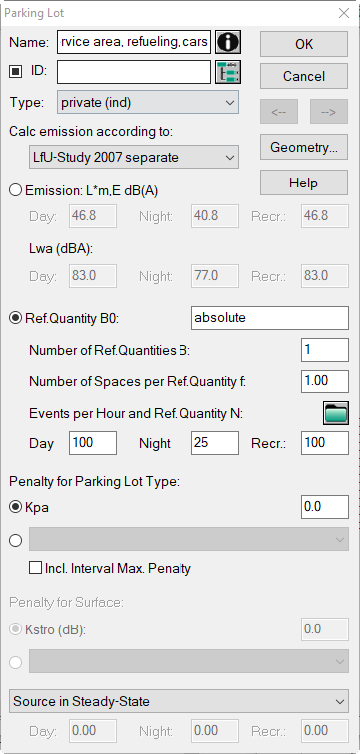
A parking lot of type „motorway service area, refueling, cars“ with 100 movements per hour during Day for the following combinations:
- When using the separated procedure the same emission level results for B=1 and N=100 movements/h or B=25 and N=4 movements/h (for Day):
 |
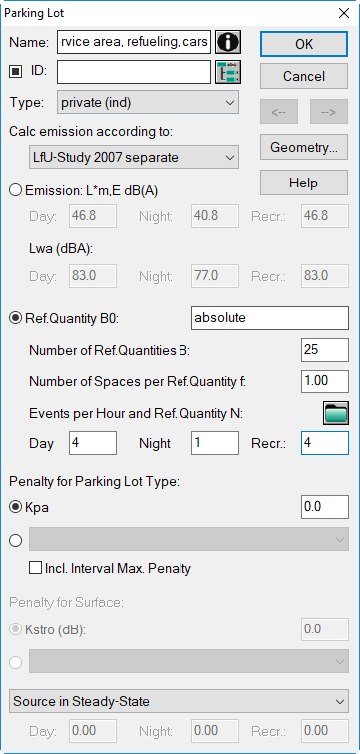 |
| separated procedure: B=1 and N=100 movements/h or B=25 and N=4 movements/h (Day) cause the same emission level, LwA,Day = 83 dB(A) | |
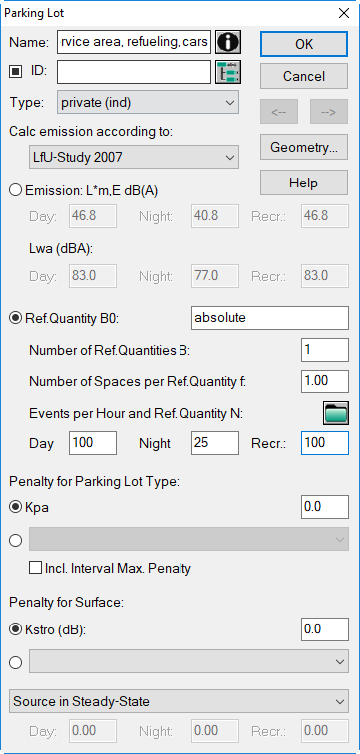
- When using the combined procedure, however, just the input of B=1 and N=100 movements/h (Day) generate the correct emission as the correction for search and passage of vehicles is calculated from the number of movements only:
 |
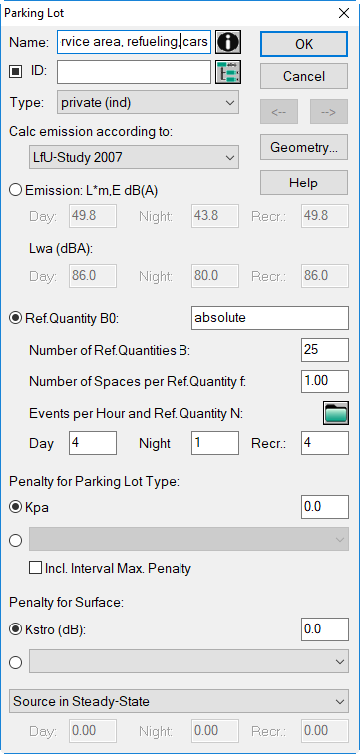 |
| combined procedure: B=1 and N=100 movements/h (Day) or B=25 and N=4 movements/h (Day) cause different emission levels. Just B=1 and N=100 movements/h (Day) yields the correct emission level (KD=0 dB as f*B<=10)! | |
Note
As the combined procedure predicts the correction KD due to search and passage based on the product (f*B), and as the parking lot types with absolute number of events do not have search and passage events, it follows from B=1 for the correction KD=0 dB.
Parking Lot Types accord. to LfU-Study 2007
| Name | Reference Quantity B0 | No. of Spaces/RefQ f | Events/h/RefQ Day N | Events/h/RefQ Night N |
| park-and-ride parking city nonchargeable | 1 Parking space | 1.00 | 0.300 | 0.060 |
| park-and-ride parking nonchargeable | 1 Parking space | 1.00 | 0.300 | 0.100 |
| motorway service area, refueling, cars | absolute | 1.00 | 40.000 | 15.000 |
| motorway service area, refueling, trucks | absolute | 1.00 | 10.000 | 6.000 |
| motorway service area, resting, cars | 1 Parking space | 1.00 | 3.500 | 0.700 |
| motorway service area, resting, trucks | 1 Parking space | 1.00 | 1.500 | 0.500 |
| housing estate, underground parking | 1 Parking space | 1.00 | 0.150 | 0.020 |
| housing estate, parking | 1 Parking space | 1.00 | 0.400 | 0.050 |
| discotheque | 1m² Net public floor area | 0.50 | 0.020 | 0.300 |
| consumer market small | 1m² Net sales floor area | 0.07 | 0.100 | 0.000 |
| consumer market big | 1m² Net sales floor area | 0.07 | 0.070 | 0.000 |
| discounter and beverages market | 1m² Net sales floor area | 0.11 | 0.170 | 0.000 |
| white goods market | 1m² Net sales floor area | 0.04 | 0.070 | 0.000 |
| do-it-yourself (DIY) store and furniture market | 1m² Net sales floor area | 0.03 | 0.040 | 0.000 |
| public house in city | 1m² Net public floor area | 0.25 | 0.070 | 0.020 |
| public house rurally | 1m² Net public floor area | 0.25 | 0.120 | 0.030 |
| Tavern | 1m² Net public floor area | 0.25 | 0.100 | 0.100 |
| Fast Food restaurant | 1m² Net public floor area | 0.25 | 0.400 | 0.150 |
| Drive-In | absolute | 1.00 | 40.000 | 6.000 |
| hotel (beds <100) | 1 Bed | 0.50 | 0.110 | 0.020 |
| hotel (beds >100) | 1 Bed | 0.50 | 0.070 | 0.010 |
| car park city chargeable (max 2 h) | 1 Parking space | 1.00 | 1.000 | 0.030 |
| car park city chargeable | 1 Parking space | 1.00 | 0.500 | 0.010 |