BS 5228
Note
The following specifications refer to edition 2009 of the standard BS5228-2009.
Note
BS 5228 does neither account for lateral diffraction, nor for meteorological effects.
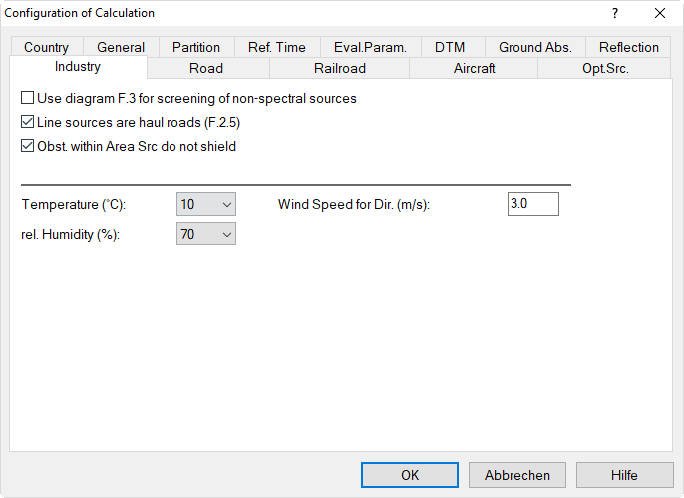
Use diagram F.3 for screening of non-spectral sources
By activating this option the spectral screening model of BS 5228 is applied to non-spectral sources as well (see figure F.3 in BS 5228). In this case, the attenuation due to screening at the specified frequency is used.
When this option is not activated the attenuation at non-spectral sources depends just on the visibility of the top of the source from the receiver (see section F.2.2.2.1 in BS 5228). In CadnaA, this attenuation depends on the path difference z:
- z < -0.25 m: Ascreen = 0 dB („visible“)
- -0.25 <= z <= 0.25 m: Ascreen = 5 dB („just visible“)
- z > 0.25 m: Ascreen = 10 dB („not visible“)
Note
The limits for the path differences are not stated in BS 5228, but result from a common agreement of UK resident users on how the term „just visible“ translates into a path difference.
Line sources are haul roads (F.2.5)
By activating this option, the propagation by line sources will no longer be influenced by soft ground. In other words, the ground attenuation being used for line sources refers always to reflective ground, independently of what ground factor G is specified.
Furthermore, the CadnaA-protocol (see Calculation Protocol) specifies in this case on column Kh’ no longer the divergence-ground attenuation term as specified by BS 5228 (see below), but the sum of the divergence and the angle correction according to:
\(K'_h=A_{div}+A_{angle}=10 \lg \frac{r_{segment}}{1\:m}+10 \lg \frac{\varphi}{180°}\)
with
- r is the distance from the center of the source segment to the receiver (m),
- ϕ is the angle of view of that source segment seen from the receiver, (degrees).
Note
In this respect, the procedure applied is similar to the one used in CadnaA for calculations according to CTRN/CRN.
| Explanatory Remarks: For mobile items of a plant, a separate model is used (section F.2.5 of the standard) which is not consistent with the general calculation method (section 2.3 of the standard). While the general calculation method accounts for the ground attenuation (over hard, soft, and mixed ground, see below) the receiver level LA,eq for well-defined routes, e.g. haul roads, results from the following equation: $L_{A,eq}=L_{WA}=-33+10 \lg Q - 10 \lg V - 10 \lg d$ with When using other equations to specify emission it is advisable to calculate the sound power level PWL beforehand and to enter this as a calculated PWL directly. This applies, for example, when using the -33 dB correction instead of -30 dB from the equation in section F.2.5 of BS 5228. |
Obstacles within Area Source do not Shield
When this option is active, any obstacle (e.g. buildings, foliage, barriers etc.) located within area sources (including parking lots and optimizable sources) provide no screening for any sub-source of that area source.
Example
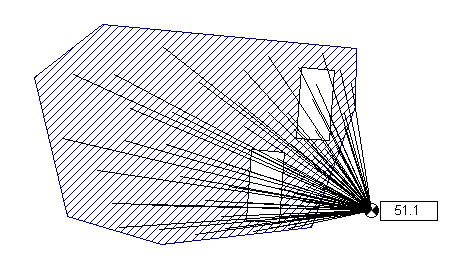
Area source with 2 buildings inside, option activated: sources with free propagation (with all rays displayed)
With this option activated the result levels are calculated as if the obstacles were not present (i.e. no screening effect).
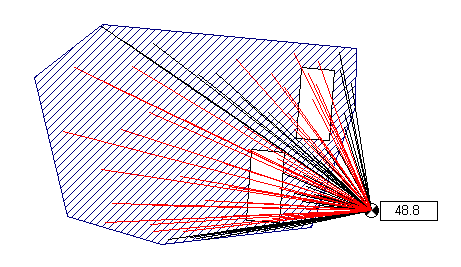
Area source with 2 buildings inside, option deactivated: sub-sources behind the buildings are screened, sub-sources in front of buildings with free propagation (screened rays in RED)
With this option deactivated lower levels result at the receiver points due to the screening effect of the obstacles inside. Nevertheless, for all other sources (i.e. sources outside of the are source’s border) the obstacles inside cause always screening.
Temperature / rel. Humidity
The air attenuation is calculated based on the temperature and relative humidity. Intermediate frequency values result from linear interpolation. The temperature specified serves also as the ambient temperature when calculating the exhaust stack’s directivity.
Additional Information
Divergence & Ground Absorption
The propagation model in BS 5228 distinguishes three kinds of situations with respect to ground attenuation. In each of these three situations the calculation in CadnaA is based on the ground factor G as being entered on the „Ground Absorption“ tab (see Ground Absorption Tab).
- geometrical divergence K’h for hard ground (G=0):
\(K'_h=20 \lg r + 8 \: dB\)
where r is the distance source-receiver
- geometrical divergence K’s for soft ground (G=1):
\(K'_s=25 \lg r + 1 \: dB\)
where r is the distance source-receiver (with r >= 25 m)
- geometrical divergence for mixed ground (0 < G <1):
\(\text{soft}=G*(K'_s - K'_h)\)
For all three settings the conditions expressed in section F.2.3.2.1 regarding the distance adjustments are respected.
Screening
BS 5228 states that in case of a barrier being present the screening effect and the ground attenuation can just be combined for hard ground. Consequently, the correction K’h is always used for the ground attenuation when a barrier is intersecting the path.
Facade Effect
BS 5228 specifies in section F.2.2.2.1 that for calculations of the noise level at a distance of 1 metre in front of a façade a correction of +3 dB has to be made.
As already with CRTN, CadnaA does not apply this correction automatically, however controlling its use by the string variable FACADE defined on the memo-window of a receiver.
Please see CRTN, Facade Effect, for details on the procedure.