Schall 03 (2014)
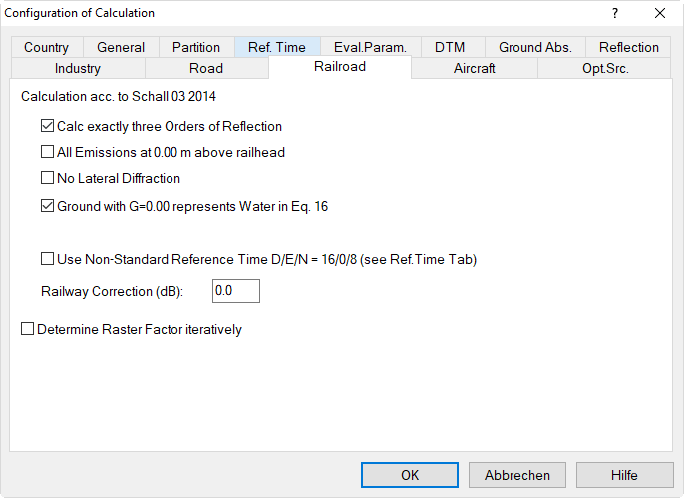
Calc exactly three Orders of Reflection
When enabled, at maximum three orders of reflection are calculated regardless of the order selected on the „Reflection“ tab (see Reflection Tab). This setting follows strictly the specifications in Schall03 (2014) 16BImSchV-2014 („reflections higher than the 3rd order remain unconsidered...“).
When deactivated, the maximum reflection order as set on the „Reflection“ tab set is considered.
All Emissions at 0.0m above railhead
When activated, all the emission of all sub-sources are set to a source height of 0.0 m above railhead (0.6 m above ground).
No Lateral Diffraction
When this option is deactivated the lateral diffraction will be considered which is normally not relevant to the receiver level due to the extension of the railway sources (line sources) in normal situations.
Ground with G=0.00 represents Water in Eq. 16
When activated all ground absorption areas having a ground factor G=0.00 are considered as water surfaces and their damping Agr,w is calculated according to equation 16 in 16BImSchV-2014.
Use Non-Standard Reference Time D/E/N
With this option deactivated the following time interval lengths will be considered: Day (D)=16 hours, Night (N)=8 hours. When this option is activated, however, the time intervals and penalties on the „Reference Time“ tab (see Reference Time Tab) are taken into account.
This option has to be activated for calculations according to END (Environmental Noise Directive EU2002/49/EG-2002) in order to consider the number of trains (or the emission parameter) during the Evening period as well.
Note
The values displayed here are updated based on the defined time intervals D/E/N on the „Reference Time“ tab.
Railway Correction (dB)
Any entered railway correction will be considered upon calculation. Thus, to consider no railway correction a value of 0 dB has to be entered.
Determine Raster Factor iteratively
According to Schall03 (2014) is has to be checked during segmentation of the railway tracks whether th receiver level/s change by less than 0.1 dB when halving all sections. If the change is larger, the halved section length has to be used.
When enabled, this condition is checked iteratively for all receivers (but not for building evaluations and grid points) until the condition is met. Consequently, at least three steps of processing runs are required to check this condition referring to the source‘s segmentation.
Additional Information
Calculation of Abar
When calculating Abar according to equation (19) in 16BImSchV-2014 the term Drefl representing the
„level correction for reflecting noise barriers at a distance ds <= 5 m with an absorbent base with height habs above the railhead“ (translation from German)
is automatically considered by CadnaA. This requires that two barrier objects are used to model this situation: one modeling the absorbent base and - when looking from the source side - a second one modeling the reflecting barrier behind it.
In order to distinguish whether a barrier has to be regarded as absorbing or reflecting the following criteria apply:
- Absorption Coefficient Alpha < 0.2: „reflecting“
- Absorption Coefficient Alpha > 0.6: „absorbing“