Internal Driveways and Areas
Vehicle noise on non-public roads or lanes inside industrial sites or plants may also to be taken into account when assessing the noise impact from such areas. This may also apply to the traffic entering and leaving the works via public roads, but being due to factory needs (e.g. transport of material, products & goods). Such internal drive ways and areas can be:
- traffic inside the works (e.g. fork lifters, tippers, and wagons),
- traffic inside pits or on race tracks,
- loading areas with fork lifts and such (e.g. loading of bulk cargo),
- harbour areas with traffic.
In these cases the calculation cannot be carried out based on a road noise standard or guideline since the emission model thereof just refers to public roads. Thus, the modeling in CadnaA makes uses the concept of the moving point source. The relevant objects to model a moving point source are CadnaA’s line and area source.
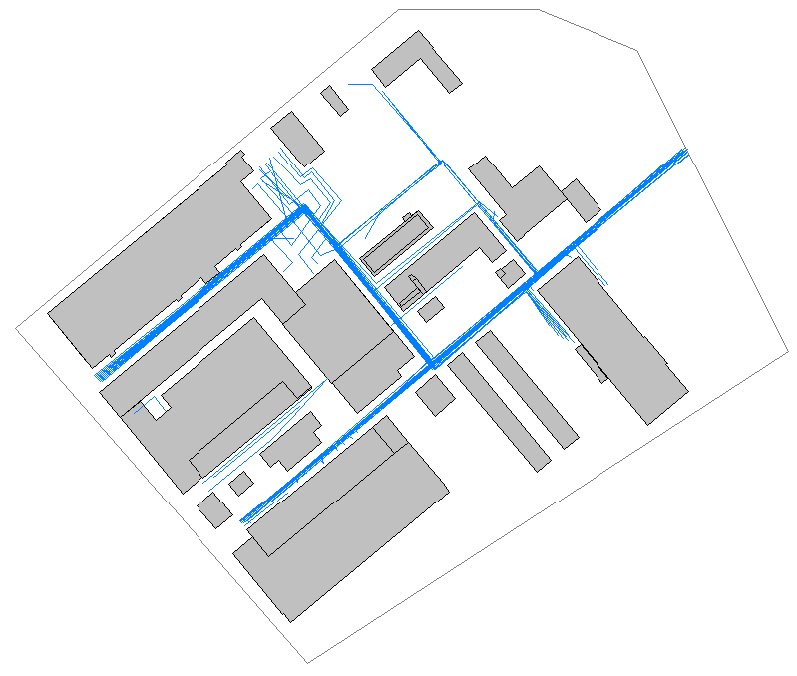
Internal traffic inside of an industrial site
Example: moving point source of line source type
- Select the line source from the CadnaA-toolbox and enter a line from two points with coordinates (x1,y1)=(100,100) and (x2,y2)=(200,100).
- Change you to the edit mode (key combination: CTRL+E) and double-click the line source.
- Switch the emission type from "PWL' " to "PWL-Pt“.
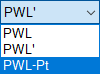
Upon this selection, the former input box for „Correction" switches to "Number/h Q" and a further input box is displayed to enter the speed.
- Enter 100 dB(A) as A-weighted sound power level of the single point source.
- Enter for number of events (i.e. pass-bys) the following values: Day/Evening/Night = 40/20/10 pass-bys per hour.
- Keep the speed of 10 km/h.
The dialog displays the resulting PWL and the PWL ' based on those values.
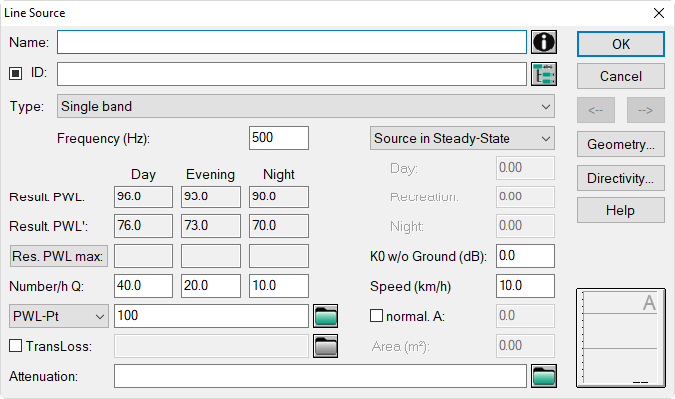
Line Source: emission based on moving point source
The A-weighted sound power level PWL calculates from:
\(L_{wA}=L_{wA-PQ}+10\lg\frac{Q}{(h^-1)}+10\lg\frac{l}{(m)}-10\lg\frac{v}{(km/h)}-30dB\)
in this example for daytime (with a source length of l=100 m):
\(L_{wA}=100+10\lg40+10\lg100-10\lg10-30dB=100+16+20-10-30 = 96dB(A)\)
Note
On dialog Geometry just the 2D-length of line objects is indicated:
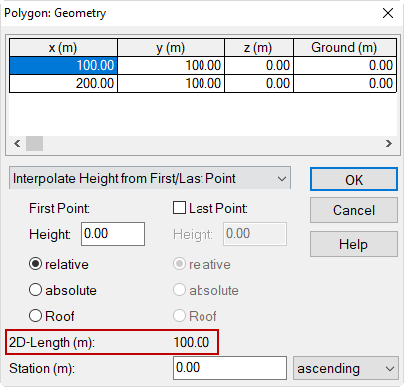
2D-length with line objects
The A-weighted sound power level PWL’ per unit length calculates from:
\(L_{wA}'=L_{wA-PQ}+10\lg\frac{Q}{(h^-1)}-10\lg\frac{v}{(km/h)}-30dB\)
in this example for daytime:
\(L_{wA}'=100+10\lg40-10\lg10-30dB=100+16-10-30=76dB(A)\)
The emission during the periods Evening and Night are 3 dB lower each due to halving of the amount of pass-bys.
Example: moving point source of area source type
An area source is used to model areas of traffic circulation in such cases where there are no driving paths or tracks explicitly defined.
- Select the area source from the CadnaA-toolbox and enter an area source defined from the following corner coordinates:
- (x1,y1) = (100, 100)
- (x2,y2) = (200, 100)
- (x3,y3) = (200, 150)
- (x4,y4) = (100, 150)
- Switch to the edit mode and double-click onto the border of the area source.
- Select on the dialog Area Source on the list box „PWL“ the option „PWL-Pt“.
- Enter an A-weighted sound power level of the single point source of 100 dB(A) and the following numbers of vehicles in the three time periods: Day/Evening/Night = 40/20/10 vehicles.
The dialog displays now the resulting PWL and PWL’’.
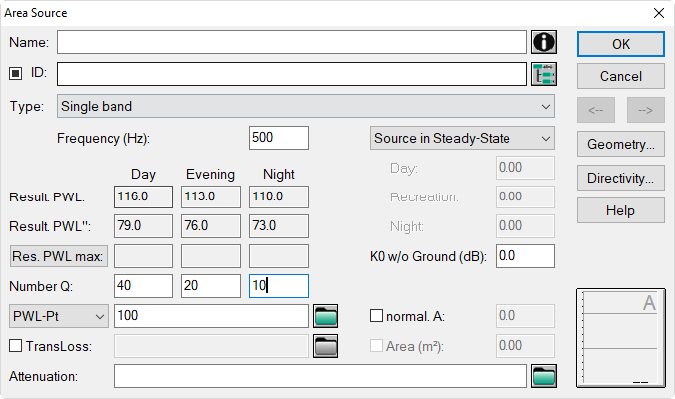
Area Source: emission based on moving point source
The A-weighted sound power level PWL calculates from:
\(L_{wA}=L_{wA-PQ}+10\lg Q\)
in this example for daytime (with a source area of S=5000 m²):
\(L_{wA}=100+10\lg40=116dB(A)\)
Note
On dialog Geometry the 2D-area (besides the 2D-length) of area objects is indicated:
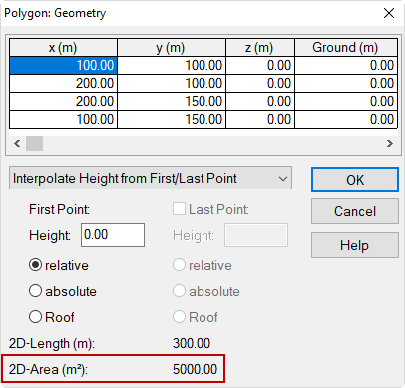
2D-area with area objects
The A-weighted sound power level PWL’’ per unit area calculates from:
\(L_{wA}''=L_{wA-PQ}+10\lg Q-10\lg\frac{S}{(m^2)}\)
in this example for daytime:
\(L_{wA}''=100+10\lg40-10\lg5000=100+16-37=79dB(A)\)
Again, the emission during the periods Evening and Night are 3 dB lower each due to halving of the amount of pass-bys.