"RIR-Evaluation" tab
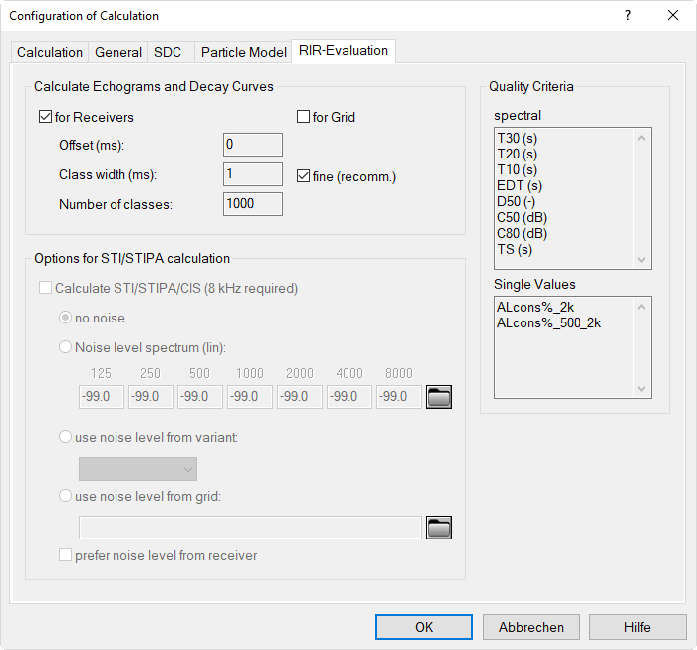
The following options are only available with the following calculation procedures: "Image Sources", "Particles" or the combined method "Image Sources -> Particles".
Calculate Echograms and Decay Curves
By activating the option "for Receivers" (with options T or AUDIO by default ON) option T or AUDIO is available) and/or - in addition - the option "for Grid" will cause the echograms/decay curves to be calculated in a subsequent recalculation (for the specified grid height, see Specification). After a calculation, the list boxes show the actually calculated room acoustic quality parameters.
- Offset (ms): The offset is set, the date from which the recording of echogram begins. With an offset of 0 ms, the runtime starts at the time of emission by the source (default: 0 ms).
- Class width (ms): The class width determines which time intervals are used in the generation of the echograms. A small value requires more space and extended if necessary, the calculation time for the evaluation. A large value reduces memory usage but it may possibly to be "rough" RIR-Evaluation for evaluation of reverberation times (default: 5 ms)
- Option "fine (recommended)": This option is only available when a maximum runtime has been set as break condition on the „Calculation“ tab, section „Particles“ (see above). In this case, the number of classes used here depends on the entered maximum runtime at a class width of 1 ms.
- Number of classes: In conjunction with the class size determines the number, the length of the considered time window (default: 200).
Note
The product of class size and class number should be sufficiently large to ensure a sufficiently large time window to determine the room acoustic quality measures (standard length of the time window: 10 s). This time limit is also dependent on the maximum expected or considered maturities.
Options for STI / STIPA calculation
On this dialog range, the STI or STIPA calculation is activated and the noise level spectrum to be used is entered or selected.
The check box „Calculate STI/STIPA/CIS“ is only available if the frequency range has been extended by the 8 kHz frequency band before (see "General" tab).
Afterwards the following options are available:
- no noise: STI/STIPA are calculated without taking a background noise level into account.
- Noise Level Spectrum (lin): Click the file selector symbol to select a noise level spectrum from the global library Noise Level (see Noise Level (global)). In this case, the selected noise level spectrum is used in the STI/STIPA calculation for all active receiver points.
- use noise level from variant: Select one of the active variants that contains the results of a noise level calculation at the receiver points. In this case, the level of the selected variant is used in the calculation of STI/STIPA.This also applies to grid calculations, provided that a level grid was calculated for the selected variant. In this case, it is used for the STI/STIPA calculation on the grid.
- use noise level from grid: This option enables to load a saved grid file representing a noise level grid. This requires to first save a noise level grid using ASCII grid format (*.rst, see Save Grid).
- prefer noise level from receiver: With the option active, the noise level entered for the respective receiver is used to calculate the STI.
Quality Criteria
After a calculation, the list boxes show the actually calculated room acoustic quality parameters.
-
spectral parameters:
- T30 (reverberation time at 30 dB decay in s)
- T20 (reverberation time at 20 dB decay in s)
- T10 (reverberation time at 10 dB decay in s)
- EDT (early decay time, in seconds)
- D50 (Deutlichkeitsgrad/Definition, no unit)
- C50 (Deutlichkeitsmaß/Speech Clarity for language in dB)
- C80 (Klarheitsmaß/Clarity for music, in dB)
- TS (center time in s)
-
single number ratings:
- Alcons%_2k (articulation loss of consonants at 2000 Hz, in%)
- Alcons%_500_2k (articulation loss of consonants, 500-2000 Hz average, in%)
- STI_male (Speech Transmission Index, acc. to IEC 60268-16, for male speakers)
- STI_female (Speech Transmission Index, acc. to IEC 60268-16, for female speakers)
- STIPA_IR (Speech Transmission Index for Public Address system, acc. to IEC 60268-16)
- CIS (Common Intelligibility Scale)
After calculation, the results (for each variant, see Variants) are displayed on the dialogs Receiver (see Receiver) and/or Receiver Chain (see Receiver Chain).
For details on the room acoustical parameters see Room Acoustical Parameters.