Room Acoustical Parameters
CadnaR the following room acoustical parameters are calculated from the backward-integrated RIR-Evaluation.
- T30 (reverberation time from 30 dB decrease of level): linear regression from -5 to -35 dB (based on the method of least squares)
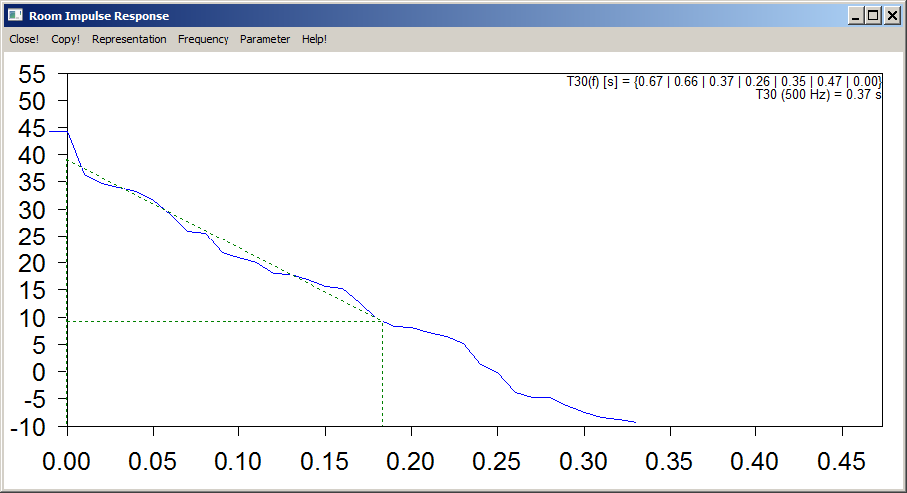
Example: RIR-Evaluation for 500 Hz-octave with regression line for reverberation time T30 (500 Hz)
- T20 (reverberation time from 20 dB decrease of level): linear regression from -5 to -25 dB (based on the method of least squares)
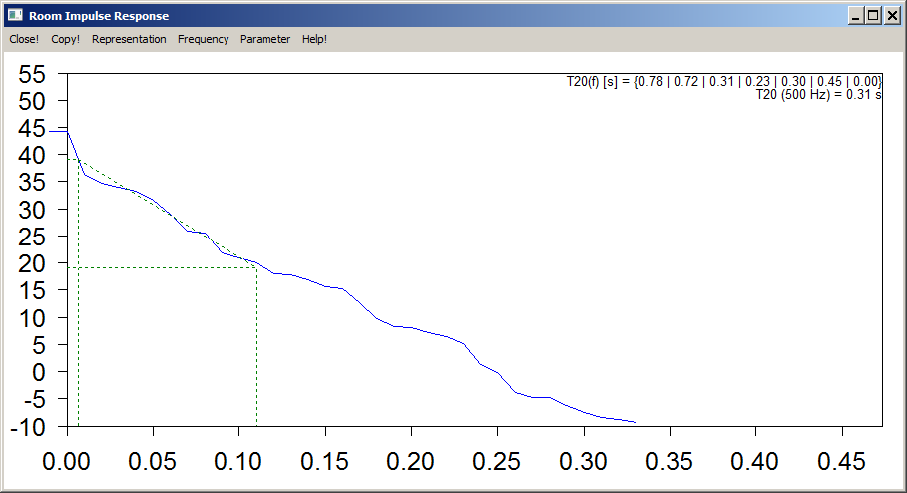
Example: RIR-Evaluation for 500 Hz-octave with regression line for reverberation time T20 (500 Hz)
- T10 (reverberation time from 10 dB decrease of level): linear regression of -5 dB to 15 (based on the method of least squares)
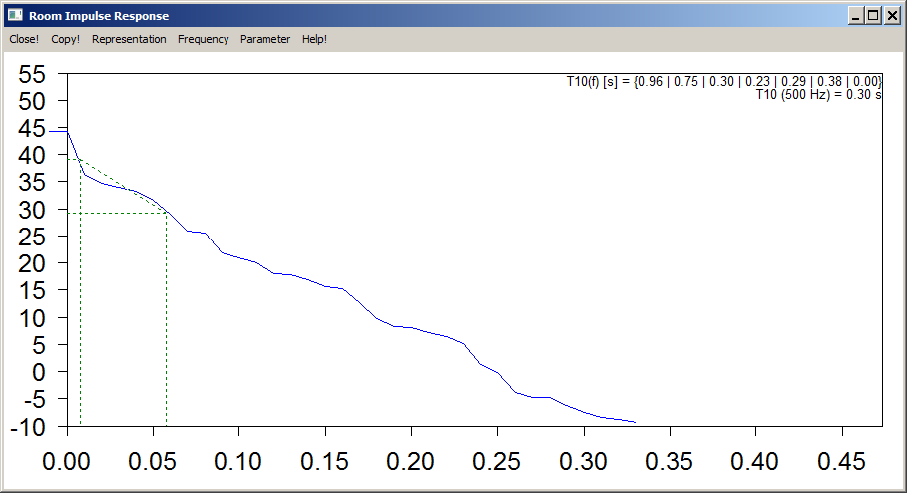
Example: RIR-Evaluation for 500 Hz-octave with regression line for reverberation time T10 (500 Hz)
- EDT (Early Decay Time): linear regression from 0 to -10 dB (based on the method of least squares)
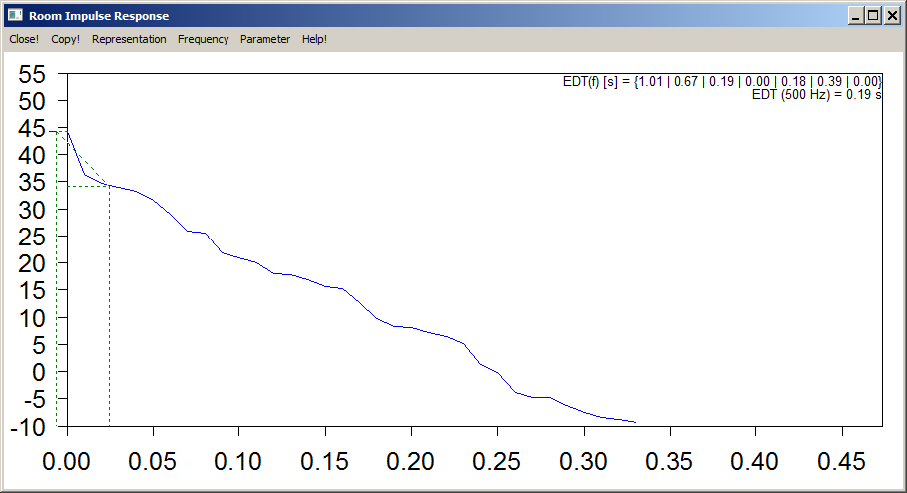
Example: RIR-Evaluation for 500 Hz-octave with regression line for early decay time EDT (500 Hz)
All four quality measures are determined from the slope of the integrated RIR-Evaluation. For each of the above listed parameters what level range of the decay curve was used to generate the regression line.
- D50 (Deutlichkeitsgrad or Deutlichkeit / Definition or Clarity, for speech):
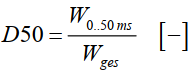
where W is the sound energy (applies also to all further equations).
Note
The starting point at 0 ms corresponds with switching off the source, i.e. this and other energy based parameters include the direct sound.
- C50 (Deutlichkeitsmaß / Clarity Index, for speech):
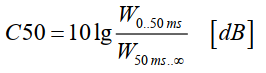
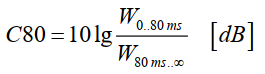
- C80 (Klarheitsmaß / Clarity Index, for music):
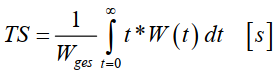
- TS (Center Time or Center of Gravity Time, for speech):
- ALcons (Articulation Loss of Consonants, for speech):

The definition is based on the RIR-Evaluation, but does not consider a background noise level. In general, ALcons% is not specified in frequency bands. In CadnaR, the following values are provided:
- ALcons_2k (2000 Hz)
- ALcons_500_2k (average from octaves at 500, 1000, 2000 Hz)
- STI (acc. to IEC 60268-16:2011)
Two values result from the calculation scheme:
- STI_male
- STI_female
The calculation according to IEC 60268-16:2011 may consider or not the effect of background noise. In CadnaR, this depends on the settings on the "RIR-Evaluation" tab (see Configuration).
-
STIPA acc. to IEC 60268-16:2011 (Speech Transmission Index for Public Address Systems)
-
CIS (Common Intelligibility Scale acc. to Barnett):
CIS results from STIPA according to:
\(CIS=1+\lg(\text{STIPA})\)
This equation holds provided STIPA>0.126.
Typical Value Ranges
From the available literature Literature, Literature, Literature, Literature] the following value ranges for each of the room acoustical parameters can be quoted:
| Parameter | Freq. Range | Optimum for Speech | ... for Music |
| T30 T20 T10 |
500-1000 Hz | ca. 1 s *) | ca. 1.5 s *) |
| EDT | 500-1000 Hz | - | ca. 2,2 s *) |
| D50 | 500-1000 Hz | > 0.5 | - |
| C50 | 500-1000 Hz | > 0 dB | - |
| C80 | 500-1000 Hz | - | -1 to +3 dB |
| TS | 500-1000 Hz | < 80 ms | 100-150 ms |
| ALcons_2k | 2000 Hz | <=12% Ranges: < 3% ideal intelligibility 3..8% very good i. 8..11% good i. 11..20% poor i. > 20% worthless i. |
- |
| ALcons_500_2k | 500-2000 Hz | ||
| STI_male | 125-8000 Hz | >=0,5 Ranges: 0..0,3 poor intelligibility 0,3..0,45 satisfactory i. 0,45..0,6 good i. 0,6..0,75 very good i. 0,75..1,0 excellent i. |
- |
| STI_female | 250-8000 Hz | ||
| STIPA | 125-8000 Hz | see STI | - |
| CIS | 125-8000 Hz | >= 0,7 (STI>=0,5) | - |
*) depending on the room volume V and type of use (values above hold for V=ca. 1000 m³)
Literature
- Fasold, W.; Veres, E.: Schallschutz + Raumakustik in der Praxis, HUSS-MEDIEN GmbH, Verlag Bauwesen, Berlin, 2. Auflage 2003.
- Ahnert, W.; Tennhardt, H.-P.: Kapitel 5 - Raumakustik, in: Handbuch der Audiotechnik (Hrsg.: S.Weinzierl), Springer Verlag, Berlin/Heidelberg, 2008.
- DIN EN ISO 3382-1, Akustik - Messung von Parametern der Raumakustik, Teil 1: Aufführungsräume, 2009-10.
- DIN 18041, Hörsamkeit in kleinen bis mittelgroßen Räumen, 2016-03.