Diffuse Field Model
The classical method to calculate the sound level in rooms originates from the work of W.C.Sabine. The statistical theory of sound reverberation in rooms assumes an entirely diffuse sound field. In this case the level in the so-called „diffuse field“ of a source is independent from the location. The sound pressure level is determined only by the source parameters (sound power) and the absorption by the room surfaces.
Note
With the statistical theory no rays to receiver points can be displayed (see Receiver, option „Generate Rays (as Auxiliary Polygons)“).
Calculation
Mean Absorption Coefficient
The mean absorption coefficient per room surface results from:
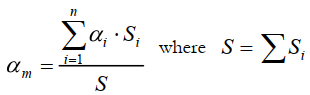
where Si: area of a partial surface i
Conversion third-octave to octave values of the absorption coefficient:

Note: This way of averaging - compared with the arithmetic mean - results from the assumption that the attenuation of level due to multiple reflections in the room should be the same with octaves than when using three third-octaves (with L3rd-oct = Loct - 10 lg 3 each).
Mean absorption coefficient of the room:
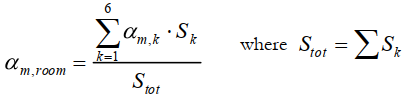
Effective Absorption Coefficient
The effective absorption coefficient per room surface refers to the octave values Lref,j of the specified reference spectrum (see Configuration):
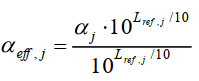
effective absorption coefficient of a room with total surface Stot:
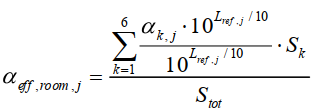
Equivalent Absorption Area
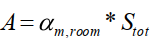
Sound pressure level at distance r:
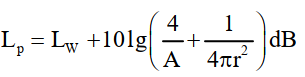
where
-
LwA: sound power level in dB
-
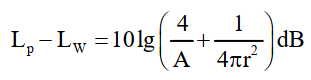
A: equivalent absorption area of the room (m²)
-
r: distance source - receiver (m)
On the diagram the level difference Lp-Lw is displayed:
Reverberation Time T
-
according to Sabine:
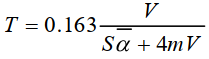 with air absorption
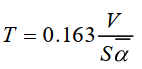 without air absorption
 -
according to Eyring:
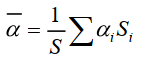
where
-
S: total surface of the room (m²)
-
V: room volume (m³)
-
m: frequency dependent damping constant depending on temperature & relative humidity and